Category: Technical Analysis

  • Can You Afford to Ignore This Divergence, Now?

    Can You Afford to Ignore This Divergence, Now?

    The last time I mentioned this divergence was in November 2007 and it did flash future turbulence, later to be known (and still is) as The Great Recession. This 100 year old indicator can’t be used for day to day market movements but it can define turning points on the macroeconomic level.

    Are things different today vs 2007? Yes and No.

    While this divergence is technically the same, there are some abnormalities in the stock markets today. And the top of the list is “role of central banks” around the world and various “plunge protection team(s)”. The “unlimited” supply of money, in the form of QEs markets, does act like an inherent PUT option which might also explain why markets haven’t suffered even a 10% pullback for quite some time now. In fact, this is one of the longest Bull runs in the entire history of US stock markets.

    Still, even after factoring those differences, we can’t ignore this glaring divergence between Dow Jones Industrial and Dow Transports. In fact, it is so vivid that yesterday after Fed announcement, Dow briefly scaled to all time high, while Dow transport was slipping almost 2%!!!

    Dow Theory Latest

    The price movement analysis based on these two indices i.e. Dow Jones Industrial and Dow Transports is called The Dow Theory.

    There have been other instances of Dow Industrial and Dow Trasnports divergence during the past few years. However, one that clearly stands out is Sep/Oct 2013 when Dow Jones was making a higher high but Dow kept on drifting lower i.e. non-confirmation and we all can see what happened in next few months.

    So what does this mean? what do I need to do? Should I sell my stocks and convert to cash?

    [testimonial_slider disable_height_animation=”true” autorotate=”5000″] [testimonial name=”Anna, Singapore” quote=”As a direct result of learning under him, $7000 profit during the last three months alone . My trading skills as well as results have improved significantly.” id=”t1″] [testimonial name=”J, Spain” quote=”0% to 50% with a quite high success rate. As a direct result of OP’s strategies I have made a positive cash flow of $34,000/- within a short period of time.” id=”t2″] [testimonial name=”Luis González, USA” quote=”..16 years witnessing my capital being managed by different brokers….Option Pundit is well tuned with the market and exhibit option trading techniques far more sophisticated than my previous options brokers…” id=”t3″] [/testimonial_slider]

    I am NOT suggesting that there is market downtrun right here even though I think we have at least short term peak here (SPX 2140+/-). However, As someone who has been trading these abnormal markets, you have to keep in mind all the flashing red signs so you can PREPARE your plans. No one can pick the top or the bottom. At the same time, one may have to keep dancing as long as music is being played too…but…dance as close to exit door as possible. The exit door is getting smaller day after day.

    Here is a bit of Dow Thoery history (source- Wikipedia) – The theory was derived from 255 Wall Street Journal editorials written by Charles H. Dow (1851–1902), journalist, founder and first editor of The Wall Street Journal and co-founder of Dow Jones and Company. Following Dow’s death, William Peter Hamilton, Robert Rhea and E. George Schaefer organized and collectively represented Dow theory, based on Dow’s editorials. Dow himself never used the term Dow theory nor presented it as a trading system.

    Profitable Trading, OP

  • How High is High for S&P500?

    It’s been 5 years since markets bottomed in Mar’09; S&P500 touched 200days moving average during Nov’12 and since then it has been almost 15months for this uninterrupted move. Markets have withered all kind of storms be it weather, taper-on/taper-off tantrums, government shut down, debt ceiling and all sorts of macro-economic data good or bad. Good was/is good, bad was/is even better. Currently 200dma ties to 1730+/- just a few points shy of Feb’14 low.

    Many of you have been asking>>> So how far can this run go? How High is High?

    As such in current ctrl+p environment, sky is the limit! But really, Who knows and who cares as the only direction know to many is “up”. So let’s review how far this can go (besides going through the roof, if there is any?)

    Based upon how I view recent price action, I see an immediate resistance (major or minor, I don’t know) around $1882+/-, followed by 1920 and the major one at around 1975+/- which is just roughly 100 points away.

    The bullish argument is that S&P might be breaking through the inverse Head & Shoulder pattern which might lead to explosive move. As per bearish argument, my eyes are spotting a broadening top at current levels, which also has an immediate resistance around $1882+/-; there are multiple negative divergences as well.

    And also, worth pointing our is the fact that while all other indices are making new high, Dow Industrial and Dow Transports are still below their recent high.

    So here you are, choose whichever side you are comfortable with but trade carefully.

    Profitable Trading, OP

  • First Sell Signal of 2013

    It was yet another 90% down day, after an “interesting” Friday as expected. I did mention about purchasing some OOM calls before market close on Thursdays in anticipation of Friday move (which follows a consistent pattern). Yesterday was highest intraday range for SPX since Nov 7 drop. As of close Feb 25 2013, I have the first sell signal of 2013 when both of my vol indicators are in the SELL Mode. This drop benefited our positions for OPNewsletter (DIA bearish diagonals) and RUT OOM bearish butterfly. And the wait was worthwhile, now we can open new portfolios for OPNewsletter.

    So far, there are some predictable patterns that are helping in exacting the prices-
    – I mentioned the upside on SPX was 1528-30, this high was 1530.94!!

    – The RUT high was 932.0016, which was exact point i shared as my last line on RUT ($932 +/-5) and what a pullback we are seeing from there!!

    Not a big rocket science. It’s just that it is following some pattern (until it isn’t). I have already shared my thought on GOOG and AAPL. There a lot of other stocks which has already given primary sell signals that I shall be sharing with OPNewsletter members via OPNExtra!

    Recall I mentioned my key learnings at the beginning of the year, I am playing to the tunes of music Uncle Ben is playing, but I am dancing closer to the door. The next support level for SPX is around 1476, and if you didn’t exit around 1528-30; you may want to consider this door and comeback at better prices or when the rally resumes.

    Buy and Sell Turns of S&P500

    Chart is attached for one of the indicators I use. You may see the effectiveness. I fine tune it with the help of 2nd indicator which is not shared. As with other indicators, this doesn’t work very well during choppiness but following this indicator alone, would have generated some massive gains e.g. Mar 2012 (almost 100points), Oct 2012 (almost 100 points), Dec 31/2012 (almost 105 points)…these were mentioned in OP forums as and when those were triggering.  Is every sell signal a sell signal? not necessarily. But every selling was preceded by the sell signal. 

    Have fun. if we do get pull backs ahead, please don’t forget to share with others that you were shared this at OptionPundit firsthand
    (if you would like to join for OPNewsletter, pls click here

    Disclaimer- This is for information and entertainment. Nothing mentioned here is an investment advice. Pls do your due diligence before investing

  • How Do I Trade Future Options Using Price Action

    Trading future options is a different strategic play vs trading options on equities or indices. While there are differences, there are similarities as well. Below article will provide basic idea of how and what kind of trading set-ups we are looking for when placing directional trades on Futures utilizing various option trading strategies. Please read and let us know if you have any questions, feedback via posting in the comment section.

    Getting Clues to Market’s Next Move

    Is it possible to trade or read the markets without indicators? Can traders really get a better grasp of market strength or weakness without indicators? Of recent years, more and more traders are going back to the basics and interpreting market direction or strength with only price movements. Although I do not make my trading decisions exclusively on price movements, I must say that I get a lot of clues about market’s next possible move from reading price alone.

    As markets climb higher or tumble, they seldom move in one straight line. Markets usually move in a zig zag manner and it is this manner of movement that provides directional clues for alert trader. From this point on, for ease of reference, I shall refer to this manner of movement as market structure.

    Market Movements

    Timing the Markets Without Indicators

    We often hear or read that markets will make higher highs in an uptrend and lower lows in a downtrend so how do we make use of this to time the markets? The principle is actually quite straight forward. For example, when a weekly chart is showing higher highs and higher lows, the daily chart is likely to exhibit the same behavior.

    (more…)

  • Why and Who is Buying Puts now?

    Markets are rallying, but then why and who is buying those S&P500 puts? Why is there such a steep premium between VIX Cash Index and VIX Future prices. The Spread is at the widest. The CBOE Skew Index is in the top quartile, Credit Suisse Fear Barometer (CSFB Fear Index) is at record levels. If everything is rosy, then why such bearishness?

    To explore more, On Friday I was discussing with Bill Luby author of Vix And More (An educational interview with Bill) about the steep premium that is reflected in the VIX future prices. The discussion also involved how and what kind of option trading strategies we could use to benefit from such an environment. The discussion pointed me to an article written by Mr Lawrence McMillan in Aug 2010. I shall strongly encourage you to read that article (Here is the original article) by Lawrence who is one of the original thought leaders of option trading world.

    McMillan observed that On Jul 20, 2010, the largest premium spread between VIX Cash Index and VIX Futures was about 9 point and such a steep premium comes towards the end of a rally. He also provided some historical references-

    There is some precedent for this. Note that the current differential between VIX and the highest futures price is about 9 points. That’s the highest/steepest on record (there were bigger futures discounts in the fall of 2008, but there have never been larger futures premiums). Two other times this year, the term structure became very steep. The first was in mid-January, when the differential between VIX and the highest futures price reached about 7 points. A severe market decline of 100 SPX points (intraday) followed very quickly thereafter. The second was in late April, when the differential reached 8 points at its steepest. SPX soon followed with a drop of 180 points.

    It’s no secret what happened in late July/Aug 2010, S&P500 quickly dropped by almost 350 points.

    Current VIX future premium over VIX cash index are one of the largest seen in the history. Even higher than what was present during Jul 2010. On July 20, the highest spread was between Jan 2011 and VIX and it was 9.02. As of Yesterday close, the highest premium spread between VIX Cash index and VIX futures is +11.56 for Oct 2012 and onwards. Pls see attached Chart for the VIX Futures premium. Actually it is almost 2.0 points lower vs. what I shared with OPNewsletter members on Friday Feb 24, 2012 when the largest spread was +13.7!!!

    VIX Cash Index vs VIX Future Prices

    Naturally such a high level of fear is reflected in the Credit Suisse Fear Barometer (CSFB) which is currently at 5 year high. Those who don’t know what is Credit Suisse Fear Barometer is here is the description- The CS Fear Barometer measures investor sentiment for 3-month investment horizons by pricing a zero-cost collar. The collar is implemented by the selling of a 10% OTM SPX call option and using the proceeds to buy an OTM put. The CSFB level represents how far out-of-the-money that SPX put is. The higher the CSFB level, the greater the fear.

    Credit Suisse Fear Barometer at Record High

    How could you take advantage of such scenario- One less speculative, hedged strategy that Mc Millan suggested was to buy VIX Puts/ Buy SPY Puts. At that time, suggested ratio for 5:3 respectively but you may choose different ratio based on your profile/ volatility analysis. For OPNewsletter members, we are using different Option Trading Strategy which has less risk if VIX stays where it is, but gains significantly if VIX spikes sharply. Keep in mind though that no one can time the markets and thus till the time VIX is not going anywhere, the premium may remain elevated and theta may eat into your gains. So keep a close eye.

    You may choose ignore current market scenario and be a contrarian assuming that when such levels of bearishness exist, it’s bullish. However, I am not bullish camp and will not be bullish unless SPX can clear 1376/1385 zones. SPY again gapped down roughly 0.5% at the open but recovered to close at a 52-week high (it’s now > 5times), and VIX has been rising. This is usually not associated with great performance going forward.

    If you would like to join for the OP Income Newsletter, pls click here to sign-up for the membership waitlist.

    In any case, whatever you choose/trade, be careful.

    Profitable Trading, OP

  • Get Ready

    Making predictions is a risky business. As a market participant, the best one can do is to make forecast and assign probabilities. Since my last post, markets have been grinding higher but the pace is slowing down. Nothing significant has been achieved on big picture basis. At times, I think it’s Greece that’s keeping markets alive; because at one point, the deal is done only to find that it mean nothing much the next day, but by then markets have already moved on.  The again, after some pause, there is a deal which again falters the next day and this “deals is, deal isn’t” story has been continuing for the past 2 years. And in between “the deal is, the deal isn’t” is the “timing” of news which makes it difficult to trade markets. Those who day trade know what I mean.

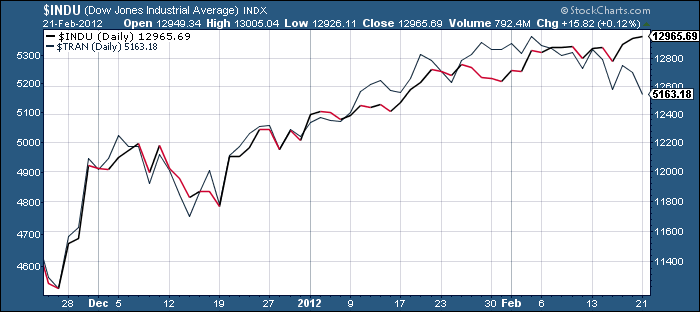
    Moving on to US markets. S&P500 hit 1367.76 yesterday; the cracks are already appearing beneath the surface. Almost every key analytical tool that I use is flashing “get out”, at least for short term. Be it old theories like Dow Theory or Modern volatility based indicators, all are saying “exit” (based on the way I use them).  Having said that, forecasting right and being right on time are two separate things, especially for an option trader. As an option trader, you may forecast right but if you are off time, Mr theta will come and take away his share slowly.

    Divergence in Industrial and Transports

    Internals aren’t great either, the A/D line is diverging with price action in S&P 500 and New highs topped on Feb 3rd (at least for now). Dow has already hit almost 100% gains since Mar 2009 lows. What does all this mean to me? The “probability” of going higher is lower vs probability of markets going lower. If S&P can clear 1375 and stay there, then all of the above analysis will be void.

    So for whatever worth it might be, I will suggest booking profits (if you were riding the trend) and wait for a better entry to re-enter the markets. 2012 will be an interesting year.

    Profitable Trading, OP